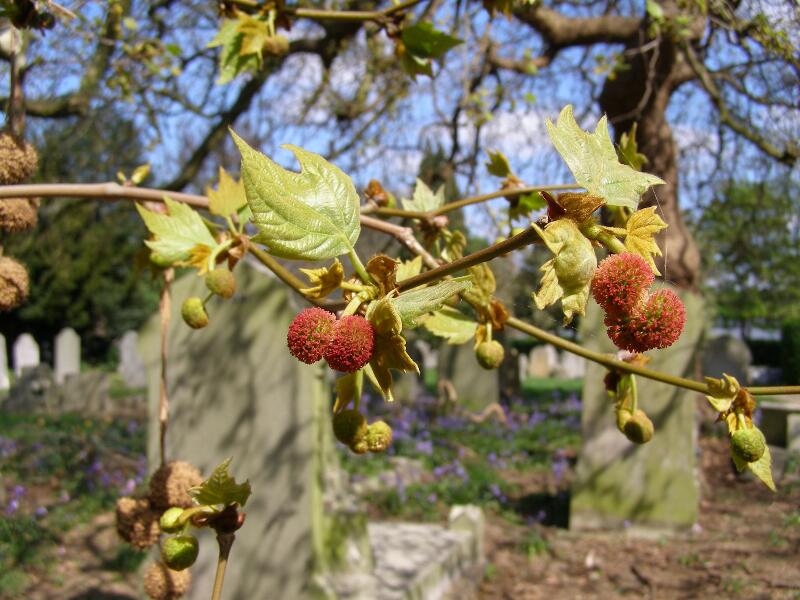
Flowers of a form of Platanus orientalis;
showing the prominent reddish female flowerheads, and
the less showy yellow male flowerheads.
Plane trees of London
Botany |
The genus Platanus is the only one in the dicotyledon family Platanaceae. It arose early in the evolution of flowering plants, and fossil specimens are known from the earlier Cretaceous period, over 100 million years ago.
There are about 6-10 species, depending on botanic authority. All are from the northern hemisphere, mostly in temperate regions. Two species are from the Old World; Platanus kerrii is the only tropical species, found in Indochina, and it is sometimes placed in a separate subgenus. Platanus orientalis is found from western Asia possibly also as far east as the Himalaya to southern Europe. Several others, including Platanus occidentalis, Platanus racemosa, Platanus wrightii, Platanus lindeniana are from North America. All are deciduous except Platanus kerrii.
Flowers of a form of Platanus orientalis;
showing the prominent reddish female flowerheads, and
the less showy yellow male flowerheads.
Their preferred natural habitat is river valleys and wetlands in warmer temperate regions, but they can tolerate dry conditions after establishment. All are large trees, generally 20-50m high.
A common characteristic is flaking bark that peels away in sections or sheets, leaving a dappled trunk. This is due to a lack of flexibility in the bark, so that as the trunk grows, the bark cannot adapt to it, and separates from it.
Leaves are borne alternately on the stem. They are always simple. In most species they are palmately lobed and veined, though in Platanus kerrii they are unlobed, pinnately serrate and pinnately veined. Juvenile leaves are distinct from adult leaves, being more deeply and narrowly lobed in most species. The axillary bud on the shoot is covered completely during the growing season by the base of the petiole, which may be swollen to accommodate it. The shoots and young leaves are covered by hairs or a fine down when young, this is probably to protect the young tissue from sunlight and water loss. The hairs are usually shed as the leaves mature, but sometimes they are partially retained on the underside of the leaves. Stipules are usually present, part of each stipule forming a tube around the shoot, the rest of it forming a leaf-like extension.
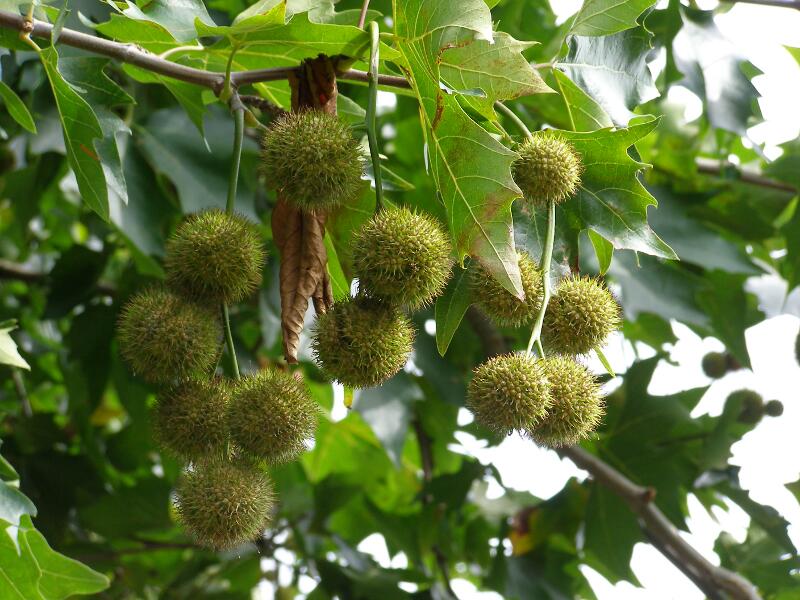
Fruit bodies in summer
Plants are bisexual - both sexes borne on the same tree. Male and female flowers are borne on separate spherical inflorescences, which hang on fibrous stalks. They are wind pollinated. The female flower-heads are larger and more showy, generally greenish flushed red or purple, colour varying with the clone, sometimes entirely green. The male flower-heads are smaller, usually a pale yellow to yellow-brown colour. The flowers form dense spherical heads, sometimes separately stalked, 1 to 12 on a stem. Of the species usually seen in Britain, the oriental plane has the greatest number of female flower heads per stem, up to 6. There may be between 3 and 8 each of petals and sepals. There are between 3 and 4 anthers on the male flowers and between 6 and 9 pistils on the female flowers. The flowers may be covered by hairs, in the same way on the leafy shoot. Each female flower becomes an achene, united with the others on the flower-head to form the spherical fruit. Often the styles persist to form bristles or prickles on the seed, and they aid dispersion of the seed. The fruits persist through the winter on the temperate species. They then disintegrate in early spring, generally while still on the tree, releasing the achenes.
The generic name Platanus was published by Linnaeus. The oriental and occidental planes, Platanus orientalis and Platanus occidentalis were known to him and named by him. The hybrid between these would have been in existence during his life, but it was named later.
There is some disagreement about the correct specific name for the London plane. The principal contenders are;
Platanus x hispanica Muenchhausen. This name was published in 1770, based on a description by Miller from a now untraceable source. Augustine Henry believed that Miller was describing the clone now named after him, Platanus x acerifolia 'Augustine Henry'.
Platanus x hybrida Brotero. This was based on a tree which Brotero suggested might be a hybrid, but which Bean feels cannot be reliably identified.
Platanus x acerifolia Willdenow. This is based on a descripton by Aiton. This name was published in 1805, and hence both other names above have priority. However, this name is in widespread use now, more so than its closest contender, P. x hispanica. Bean makes a case for it to continue to be used on the basis that the specimens described for the other two names cannot be reliably identified. Santamour and McArdle describe his arguments as 'not entirely convincing', but agree that this name should continue to be used. It is used on this website.
Naming according to some standard works and institutions;
The common name for the genus is 'plane' in British English, 'sycamore' or 'planetree' in American English. Variations of 'platane', 'platano' are used in much of Europe, names derived from the Greek 'platanos' or 'platus', meaning broad, and referring to the leaves. In the region from Turkey to Kashmir, variations of the Persian name 'Chinar' or varians such as 'chenar' or others are used. In Kashmir itself, the name 'buin' (derived from the goddess Bhavani) was originally used. In Arabic, the name 'dulb' is used though the name is also sometimes applied to some maples.
The hybrid plane trees that are grown in London are normally described as belonging to a single hybrid species, Platanus x acerifolia. It is clear on inspection that individual trees of this species are variable. Some of the distinct forms found in the capital are described on this website.
Commonly, all forms of the hybrid plane are called 'London plane' in English, both in Britain, and in other countries. However, Bean's 'Manual of trees and shrubs' uses the term 'London Plane' to refer to a single distinctive clone or group of similar trees. This clone is often found in inner London, though it becomes more infrequent elsewhere. Bean's Manual also used the name 'London Form' at least once to refer to this distinctive clone. Santamour and McArdle, in 'Checklist of cultivated Platanus' call this same clone 'London', following the usage in Bean.
Because of the possible confusion, in the rest of this web site I use the term Platanus x acerifolia 'London' to describe only the particular clone that is described in Bean's Manual (but see note below). While common in inner London, it is infrequent elsewhere, especially among the newer plantings in suburban London. The wider terms Platanus x acerifolia and 'London plane' are used in this website to describe all the hybrid forms collectively, in accordance with common usage.
Bean's Manual may have included some other similar clones, such as the one that I refer to as 'Westminster' in the description of the 'London plane' in this work. The trees are very alike in many characteristics.
Comparison table for some characteristics of the three most commonly seen plane species.
| Number of distinct leaf lobes | Ratio, width of main lobe to length of lobe. | Number of fruits per stem | |
| Platanus occidentalis | 3-5 | lobe is usually wider than long | 1-2 |
| Platanus x acerifolia | 5, rarely 3 or 7. | lobe is usually about as wide as long | 2-4 |
| Platanus orientalis | 5-7 | lobe always longer than wide | 2-6 |
The pictures below (not to same scale) shows some variations in leaf shape
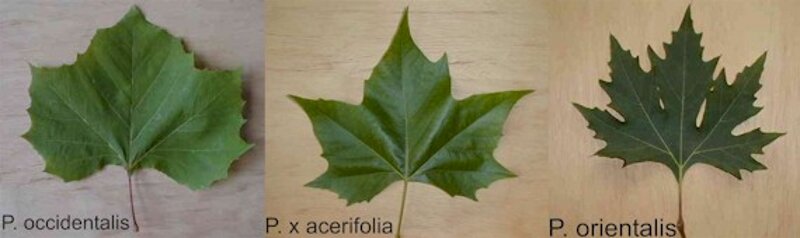
There is considerable variation within Platanus orientalis. This can be noted in different leaf shapes, branching patterns, and bark formation. However, it is possible that some of these variations in cultivated trees result from crosses with the hybrid plane, and so should themselves be considered bybrids.
The different clones of Platanus x acerifolia can vary in many of the visible characteristics. These include the leaf shape and colour, glossiness, colour and density of the hairs covering expanding leaves, bud shape and colour, stipules and their persistence, shoots, fruit size, bark colour, persistence of bark, branching habit, and the straightness of branches. In addition some of these characteristics can vary with the age and vigour of a tree, the season, and according to what part of the tree is being considered. One usually has to look at a combination of these factors to be sure which clone a tree belongs to.
The National Trust holds an NCCPG National Collection of Platanus, at Mottisfont Abbey in Hampshire. Other significant British collections are held at the principal botanic gardens, including particularly Kew Gardens and The Hillier Arboretum, Hampshire.
Many larger and older parks contain a range of different types of plane trees. As described in other pages, there may have been a greater variation in planting material in the past.
Note
I have been advised in early 2021 that I may have confused the identification of the hybrid plane clones that I refer to as 'London' and 'Westminster'. The names here therefore need to be taken with some caution, and may be changed later.
Return to index page
10-Oct-2022